The Tale of the Tape(worm)
The Story That Gave Us the Robot Boy Predicted Ozempic
 By The FuturePunk Professor
23 Sep 2026
2 min read
By The FuturePunk Professor
23 Sep 2026
2 min read
Contents
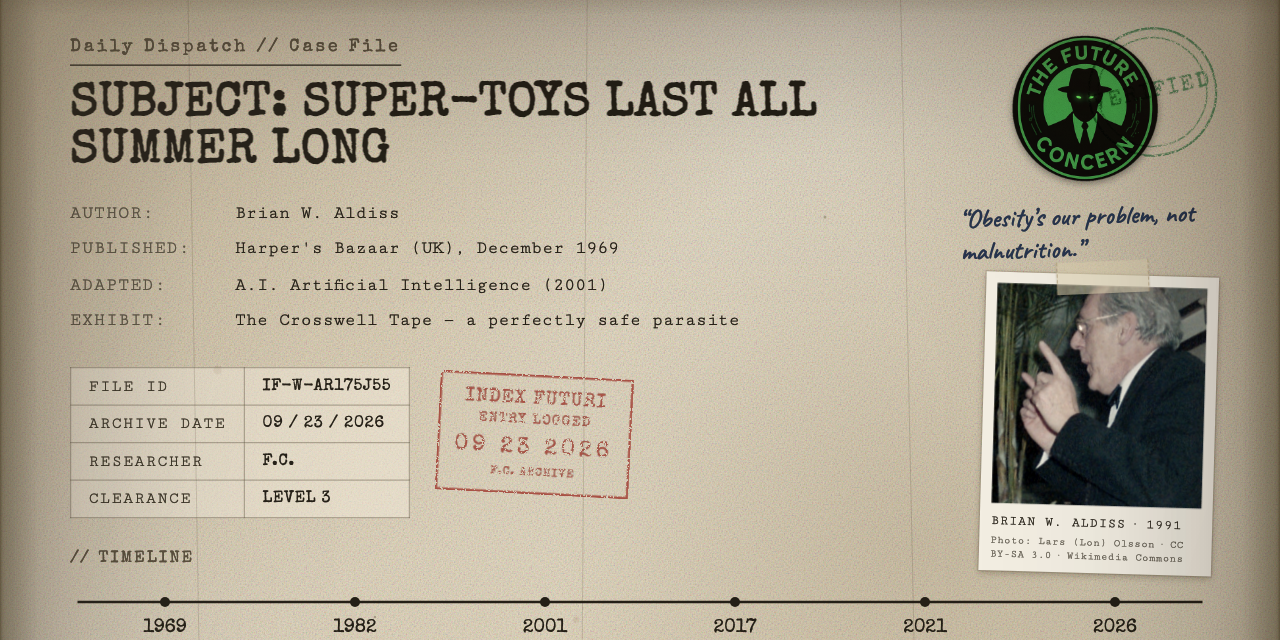
“Super Toys Last All Summer Long,” a science fiction short story written by Brian Aldiss and appearing in Harper’s Bazaar in 1969, inspired legendary director Stanley Kubrick to spend almost 20 years trying to adapt it to the screen. Steven Spielberg eventually came on to finish it as A.I. Artificial Intelligence.
Everyone remembers this story for one thing: the robot boy searching for love after being discarded by his human parents. It's probably the saddest robot story ever written.
But hiding in the original 1969 story is a prediction by Aldiss that resonates today. It might not grapple with existential questions about the nature of life, consciousness, and our responsibility to our creations, but it still hits at a fundamental aspect of our humanity: our self-image.
Let’s set the scene.
A company called Synthank is holding a luncheon, hosted by a man named Henry Swinton. They’re launching an exciting new product — a synthetic serving-man — but Swinton opens his speech with the company’s first and best-selling line, which has everything to do with appetite, so the venue is appropriate.
Even while the masses worry about their next meal, the elites concern themselves with image - and seek shortcuts to looking the way they want.
In this case, not changing their diets but remaining slim. Engineered gluttony in a world filled with starvation.
Aldiss didn't invent tapeworm-as-weight-loss-solution from nothing. The tapeworm diet was already a legend by 1969 — whispered about since the Victorians, investigated by the American Medical Association in the 1910s and '20s, but never once traced to an actual bottle. It was a back-page con so good nobody could prove it existed.
His move was to take the rumor and make it official: clinically safe, corporate-distributed, and a class marker.
In 2017, semaglutide was approved to help diabetics. In 2021, it was approved for obesity, but rumors quickly spread that everyone in Hollywood - even those already well within heightened standards of beauty - was on Ozempic. Before long, we learned the signs - a hollowing of the cheeks, and an almost non-existent appetite.
A revolutionary drug for weight loss was being used as an appetite suppressant and weight loss hack for some.
The real life version is inverted, though. The Crosswell Tape lets you eat more; the shot makes you want less.
So Aldiss got it backwards, but that’s because we don’t have food shortages (at least in most places). Instead, we have a surplus. Fitness can be considered the ultimate status symbol, because there’s no cheating. You still have to do the work. In a fast and processed food world, the amount of discipline required to stay lean can seem Herculean to many.
The shot became a shortcut to status - or to maintaining status.
So there were shortages for diabetics while the elites stayed slim.
The Crosswell Tape is here today, just with an updated social imperative. In Super Toys Last All Summer Long, there wasn’t enough, so gluttony was a status symbol.
In a world with too much, wanting less is the symbol of status.
From the Index Futuri · Super-Toys Last All Summer Long (1969) · IF-W-AR175J55
File details
- Filed
- 23 Sep 2026
- Record
- IF-DISPATCH-260923